Hospitals lose approximately $20 billion annually to claim denials, and 12% of claims were denied in 2023, according to Grand View Research’s summary of the Optum 2024 Revenue Cycle Denials Index. That figure alone should reshape how finance leaders think about the autonomous revenue cycle.
This isn’t a story about buying one more point solution. It’s about rethinking how a health system governs work, measures performance, and controls revenue risk across patient access, coding, claims, denials, A/R, and patient collections. Most organizations already have bots, edits, work queues, and analytics in place. What’s usually missing is an enterprise operating model that turns those separate pieces into one coordinated revenue engine.
An autonomous revenue cycle matters because manual intervention should be the exception, not the default. Proving that automation can do useful work is the easy part. The hard part is deciding where autonomy is safe, where human review has to stay in place, and which KPIs actually show whether the platform is improving cash flow rather than just shuffling tasks around.
Why the Revenue Cycle Can’t Stay the Same
Denials have turned RCM into a margin problem
As noted above, roughly 12% of claims were denied in 2023, and hospitals lose close to$20 billion a year to denials. For a CFO, that isn’t a technology trend to watch. It’s a direct threat to net revenue, cash flow timing, and labor cost.
The pressure builds long before a denial ever posts. Registration errors create downstream edits. Failed authorizations become preventable write-offs or delayed reimbursement. Gaps in documentation create coding rework and medical necessity disputes. Every handoff adds delay, and every delay raises the cost to collect.
What’s changed isn’t just how much automation is on the market. It’s how much financial exposure now rides on fragmented execution. Health systems that still run front end, mid-cycle, and back end work as separate operating silos usually discover where revenue slipped only after the fact.
Manual work is costly even when it looks under control
Plenty of hospitals already run useful automation. Patient access may run eligibility checks automatically. HIM may lean on coding assistance. Denials teams may work through queues and rules. Finance may get dashboards after month-end close.
None of that adds up to enterprise control on its own.
I see the same pattern in assessment after assessment. Each department can report its own productivity, but few organizations can show, in near real time, which payer rules are driving avoidable denials, where extra touches are inflating cost to collect, or whether a new piece of automation actually cut A/R days instead of just moving the work to a different team.
Practical rule: If leadership can’t connect automation activity to cash acceleration, denial prevention, and net collection performance by payer and service line, they don’t have an autonomous revenue cycle. They have a collection of disconnected tools.
That’s why the case for change is as much operational as financial. The real question isn’t whether software can complete tasks. It’s whether the organization has a governance model that sets thresholds for touchless processing, defines where things escalate, and measures whether those decisions actually improve revenue outcomes.
The shift is toward managed autonomy, with clear accountability
Autonomous RCM needs to be run as a control system, not a portfolio of pilots. Finance and revenue cycle leaders have to decide where automation can act on its own, where staff review still has to happen, and which KPIs prove the model is working.
Three management questions matter more than any technology demo:
- Which decisions should move upstream: Prevention usually creates more value than downstream rework. Eligibility, authorization, coverage discovery, and documentation readiness should all be measured for their impact on denial prevention.
- Which workflows should be touchless by design: Low-complexity claim edits, status checks, remittance posting, and routine follow-up often belong in straight-through workflows with exception routing built in.
- Which exceptions need a human: Complex coding, ambiguous payer policy, clinical validation, and compliance-sensitive cases need defined escalation rules and an audit trail.
That’s how fragmented automation turns into an enterprise platform. The goal is fewer manual touches, faster clean-claim performance, less denial rework, and better visibility into where cash gets stuck. Hospitals that make this shift can manage revenue risk earlier, before it shows up in A/R and month-end variance.
Taking the Autonomous Revenue Cycle Apart
Think in levels of autonomy, not marketing language
Most of the confusion starts with the word autonomous. In healthcare, it doesn’t mean a machine runs the entire revenue cycle with no controls. A better comparison is the move from cruise control to a self-driving system. Early automation handles one repetitive function at a time. True autonomy coordinates many functions at once, senses risk, and routes exceptions intelligently.
At the lowest level, automation sits in isolated pieces. A bot verifies eligibility. A rule scrubs claims. A dashboard reports denials after the fact. Each tool helps on its own, but none of them governs the whole process.
At the next level, systems start sharing context. A documentation issue can trigger a coding review. Payer edits can shape claim submission logic. Denial patterns can feed prevention rules further upstream. That’s the point where an autonomous revenue cycle starts to become real.
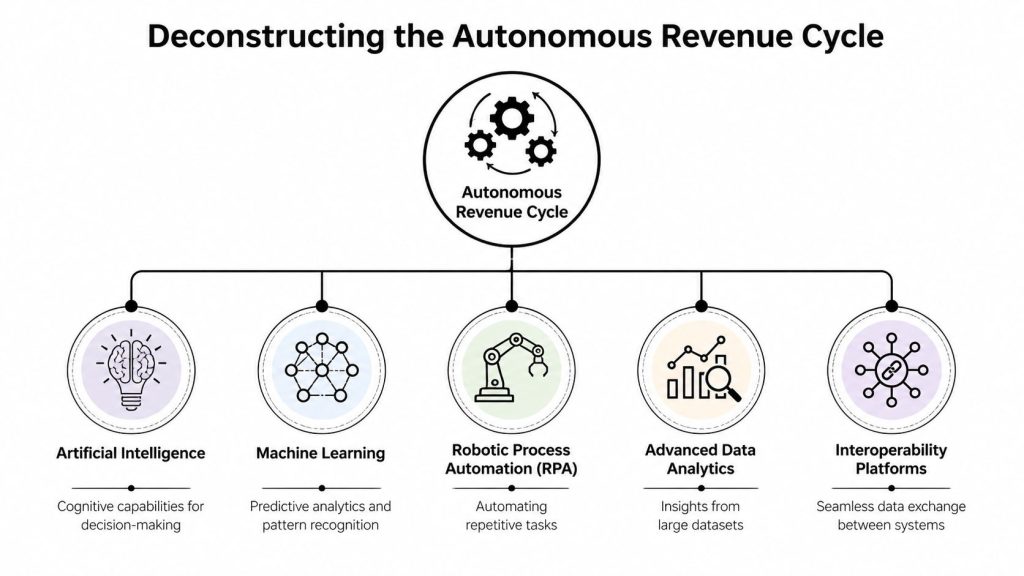
A diagram deconstructing the autonomous revenue cycle into five key technology components including artificial intelligence and automation.
The 80/20 split is worth paying attention to
Agentic AI systems can automate up to 80% of end-to-end RCM tasks, while the remaining 20% still needs human oversight because of compliance requirements, PHI risk, and shifting payer policy, according to TechTarget’s analysis of agentic AI in autonomous revenue cycle management.
That split is more than a technology benchmark. It’s a governance principle.
Treat autonomous RCM as a touchless fantasy, and leaders create compliance exposure. Keep a human in every single step “just to be safe,” and the organization never scales. The right design uses automation for volume and consistency, then saves expert judgment for cases that are low-confidence, high-risk, or policy-sensitive.
The strongest autonomous RCM models don’t take people out of the loop. They take people out of the wrong parts of the loop.
What autonomy looks like day to day
A working autonomous revenue cycle generally includes these layers:
- Front-end automation: eligibility, coverage discovery, prior authorization workflows, and registration validation.
- Mid-cycle intelligence: documentation review, coding support, charge integrity, and medical necessity checks.
- Back-end orchestration: claim edits, denial prediction, appeals support, A/R prioritization, and payment posting workflows.
- Enterprise oversight: confidence scoring, exception routing, audit trails, and financial performance dashboards.
The point isn’t that every task has to be automated. It’s that work should move through a controlled system that applies the right action at the right moment, without forcing staff to rekey data, monitor a dozen queues, or manually connect upstream problems to downstream ones.
For a CFO, the takeaway is simple: autonomy isn’t a feature. It’s an operating model built around orchestration, exception management, and financial outcomes you can measure.
The Technology Stack Behind Autonomous RCM
The autonomous revenue cycle runs on a stack of technologies that each do a different job. The most common mistake is treating them as interchangeable. They’re not. A bot, a prediction model, and a workflow engine solve different problems.

An abstract, metallic, spherical structure featuring circuit board patterns against a split black and white background.
AI and machine learning
AI and machine learning form the decision layer. They spot patterns, predict risk, and recommend actions based on clinical, financial, and operational data.
That distinction is worth noting. Mature platforms don’t just automate clicks — they interpret what’s happening across the claim lifecycle.
In practical RCM terms, AI earns its keep when it can answer questions like:
- Which claims are most likely to deny before they’re even submitted?
- Which payer patterns should change routing logic?
- Which A/R accounts deserve immediate follow-up?
- Which coding or documentation gaps are likely to hurt reimbursement?
RPA and workflow execution
Robotic Process Automation is the execution layer. It handles repetitive, rules-based tasks that don’t require clinical judgment — eligibility checks, claim status pulls, prior auth follow-up, work queue updates, and posting support are all common examples.
RPA earns its value by taking manual touch off high-volume tasks. It isn’t enough on its own, though, because healthcare workflows change too often for static rules alone to keep up. Bots are strong where a process is stable. They struggle when payer policy, documentation quality, or denial logic shifts underneath them.
NLP and language understanding
Natural language processing matters because so much revenue cycle risk sits inside unstructured text. Clinical notes, payer correspondence, remits, and appeal documentation don’t arrive in neat fields.
NLP helps the system read that content and pull out meaning that supports coding, denial analysis, and documentation review. In a well-designed autonomous revenue cycle, NLP doesn’t operate alone — it feeds AI models and workflow engines so the organization can act on what the text actually says.
BPM and orchestration
Business Process Modeling is the control tower. It defines how work moves, who owns which exceptions, what triggers escalation, and how decisions get logged.
Without BPM, organizations end up with siloed agents and disconnected automations. With it, they can standardize confidence thresholds, routing rules, SLA management, and auditability across the enterprise. Teams evaluating platform design can compare approaches in this agentic AI platform overview for autonomous end-to-end revenue cycle management.
If AI is the brain and RPA is the hands, BPM is the operating discipline that keeps the whole system aligned with finance, compliance, and operational priorities.
Putting a Number on the Financial Return
A 1 percentage point improvement in net collection rate can mean millions in recovered revenue for a hospital system. That’s why the ROI case for autonomous RCM has to be built in finance terms from day one: cash acceleration, denial reduction, labor productivity, and revenue that would otherwise leak out.
Industry estimates on AI and automation point to meaningful savings, as noted earlier. Even so, a CFO can’t approve a platform on industry averages alone. The decision gets easier once the team translates autonomy into local baseline gaps, control points, and measurable targets.
Start with where margin is already being lost:
- preventable denials tied to authorization, eligibility, or registration defects
- delayed final bill because of manual work queues and handoff failures
- underpayments that sit too long before anyone identifies and works them
- coding and charge capture variance that creates avoidable leakage
- staff time spent on status checks, rework, and low-yield account follow-up
That framing matters because autonomous RCM doesn’t create value evenly across every workflow. Some use cases pay back fast. Others need cleaner data, stronger exception routing, or better clinical documentation before the economics work.
The most credible ROI models separate hard-dollar impact from operating impact, then assign an owner and a KPI to each. Hard-dollar impact includes lower cost to collect, fewer denials written off, better yield on high-balance A/R, and faster reimbursement. Operating impact includes higher touchless rates, shorter bill hold times, fewer manual touches per claim, and less overtime in business office teams.
A finance-ready business case should answer four questions:
- Where’s the baseline today? Use current performance by domain, not enterprise averages. Start with denial rate, clean claim rate, initial pass resolution, days in A/R, cost to collect, cash posted by FTE, and write-offs tied to avoidable process failures.
- Which decision or task will the platform automate or route differently? Be specific. “Improve denials” is too vague. “Auto-route authorization-related denials for same-day correction and prevent repeat edits at registration” is measurable.
- Which KPI should move, by how much, and on what timeline? The first 90 days often show labor relief and shorter queues. Financial lift tends to follow once claim inventory turns and payer response cycles catch up.
- Who owns the result if the metric stalls? Autonomous RCM needs operating accountability. If no executive owns the variance, the project becomes a technology report instead of a cash performance program.
One practical way to frame the model is by RCM domain. Patient access tends to deliver ROI through fewer downstream defects and faster front-end clearance. Mid-cycle delivers it through coding throughput, charge integrity, and fewer documentation-driven delays. Back-end delivers it through denial prevention, smarter work prioritization, and faster cash conversion. For one focused example, see how autonomous medical coding pays for itself.
The trade-off is straightforward. Higher automation rates only improve margin if governance is strong enough to keep error rates, exception logic, and payer rule changes under control. I’ve watched organizations celebrate touchless volume while appeal inventory quietly climbs in the background. That’s not ROI. That’s deferred rework.
The better test is whether finance can point to sustained movement in a short list of measures: net days in A/R, gross and preventable denial rates, cash collections against target, cost to collect, manual touches per account, and recovery yield on worked denials. If those numbers improve and stay improved, the platform is creating enterprise value. If they don’t, the organization has automation activity without a reliable return.
Building the Roadmap and Governance Model
Most autonomous revenue cycle programs stall for a familiar reason: the organization treats them like a software deployment instead of an operating model change.

A stack of large stones floating above clouds representing a metaphorical journey or path to success.
Start with a controlled scope
Don’t begin with the most politically sensitive or clinically complex workflow. Start where there’s volume, stable process logic, and clear financial pain. Front-end workflows often make sense first, because errors there contaminate everything downstream.
A practical rollout sequence usually looks like this:
- Front-end foundation. Focus on eligibility, insurance discovery, prior authorization workflows, and registration quality controls. These create immediate operational relief and expose data quality issues early.
- Mid-cycle integrity. Add documentation analysis, coding support, and charge review where confidence scoring can separate routine work from exception work.
- Back-end orchestration. Expand into denials prediction, A/R segmentation, appeal support, and follow-up automation once upstream data quality is reliable.
- Enterprise coordination. Standardize business rules, dashboards, exception ownership, and governance across all major RCM domains.
Put governance in place before scaling
The technology can’t govern itself. Someone has to set autonomy boundaries, review exceptions, approve rule changes, and monitor financial impact. That calls for a standing governance model, not an ad hoc project team.
I usually advise health systems to define four decision rights early:
- Operations owns workflow design: Revenue cycle leaders decide how work should move, which queues should shrink, and where escalation should happen.
- Compliance sets the guardrails: This team defines where human review is mandatory, what documentation is needed, and how audit trails must be maintained.
- IT and data teams own integration discipline: They manage EHR, PM, clearinghouse, and payer connectivity, along with security and access controls.
- Finance owns the success criteria: The CFO organization decides which KPI movement justifies expansion.
Governance should answer one question clearly: when the system is unsure, who decides, how fast, and based on what evidence?
Use confidence thresholds, not blanket automation
A common implementation mistake is pushing all work through the same autonomy level. That’s both risky and unnecessary. Better models segment work by confidence and consequence.
Low-risk, routine workflows can run with minimal intervention, for example, while higher-risk cases require review before submission or adjudication. The point is to match automation to business tolerance, not to chase a theoretical touchless rate.
Once the first phase is stable, bring in broader operational education and stakeholder alignment. A short shared overview is often useful for teams that need a common frame of reference before expansion.
Change management decides whether autonomy sticks
Even good platforms stall when staff hear “autonomous” and assume replacement, black-box decisions, or added compliance risk. Leaders have to translate the model into daily reality.
That means:
- explaining which work will disappear and which work becomes more valuable,
- retraining supervisors to manage exception-based operations instead of raw volume,
- and giving staff visibility into why the system routed a case to them.
One option in this category is GeBBS Healthcare Solutions, which combines AI, ML, NLP, RPA, BPM, and analytics-driven RCM workflows across coding, claims, denials, and patient access. What matters in any platform selection isn’t the label. It’s whether the governance model, integration depth, and operational design support sustainable enterprise execution.
KPIs, Risk Management, and Vendor Selection
A fragmented automation program usually measures activity. An autonomous revenue cycle has to measure control — whether the system is preventing leakage, accelerating cash, and routing the right work to the right level of human review.
Track a balanced set of KPIs
The strongest KPI framework combines financial outcomes, operational flow, automation effectiveness, and governance controls. Don’t lean on one category alone.
| KPI Category | Metric | What It Measures |
| Financial performance | Days in A/R | How quickly the organization converts claims into cash |
| Financial performance | Cash collections | Whether revenue performance is improving over time |
| Financial performance | Cost-to-collect | Administrative efficiency of the revenue cycle |
| Claim quality | Clean claim rate | How often claims go out correctly the first time |
| Claim quality | Denial trend by payer and root cause | Where preventable leakage is occurring |
| Automation performance | Touchless task rate | Which workflows are completing without manual intervention |
| Automation performance | Exception rate | How often the platform needs human review |
| Automation performance | AI-assisted denial prevention rate | Whether upstream intelligence is reducing downstream rework |
| Operational discipline | Work queue aging | Whether exceptions are being resolved in time |
| Governance and compliance | Confidence-threshold override rate | How often staff must overrule automated decisions |
These metrics do more than support reporting. They help leaders decide where autonomy should expand, where controls are too loose, and where workflows are still too brittle for scale.
Risk management needs explicit controls
More than 50% of finance leaders are increasing automation because of staffing issues, but McKinsey’s discussion of agentic AI in healthcare revenue cycle operations notes that vendor capabilities can overwhelm organizations. That’s why customized AI and end-to-end process redesign matter more than a long feature list.
The risk areas tend to be consistent:
- PHI and data handling: Vendors must support strong access controls, logging, and secure data flows.
- Explainability: Teams need to understand why the system made a recommendation or routed a case.
- Regulatory adaptability: Payer policy shifts and compliance changes have to be manageable without rebuilding the platform.
- Operational resilience: If one workflow fails, teams need fallback paths that don’t stop cash operations.
- Exception discipline: Human review has to be structured, not improvised.
Buy the system you can govern, not the demo that looks the smartest.
How to evaluate vendors without getting distracted
A practical vendor review should focus less on the presentation and more on operating fit. Ask questions that reveal whether the platform can survive inside your environment.
Use a checklist like this:
- Integration depth: Can it work cleanly with your EHR, PM system, clearinghouse, and existing workflow stack?
- Configurability: Can your team set confidence thresholds, routing logic, and escalation paths without heavy vendor dependence?
- Auditability: Does it produce explainable decisions and durable audit trails?
- Scalability by service line: Can it support the differences across hospital departments, physician groups, and payer mixes?
- Governance support: Does the vendor help define operating rules, ownership, and KPI measurement, or just install tools?
- Operational transparency: Will you see performance at the workflow and exception level, not just the dashboard headline?
For teams comparing service models and governance expectations, these critical considerations when choosing an outsourcing partner are a useful supplement.
The right vendor won’t promise frictionless autonomy everywhere on day one. They’ll show where autonomy is appropriate, where human review stays necessary, and how performance will be measured over time.
Healthcare Finance’s Next Chapter Is Autonomous
The autonomous revenue cycle is no longer a future-state concept for innovation committees. It’s becoming the practical model for health systems that need tighter financial control, faster cash realization, and less operational waste.
The winners won’t be the organizations with the most bots or the loudest AI story. They’ll be the ones that build disciplined governance, tie automation to real KPIs, and design human oversight into the workflows that carry financial and compliance risk. When that happens, RCM teams spend less time chasing preventable errors and more time protecting revenue and supporting patient care.
GeBBS Healthcare Solutions helps hospitals and health systems modernize revenue operations across patient access, coding, claims, denials, A/R, and analytics. If your team is evaluating how to move from fragmented automation pilots to a governed autonomous revenue cycle, explore GeBBS Healthcare Solutions to assess platform capabilities, operational support, and enterprise RCM alignment.