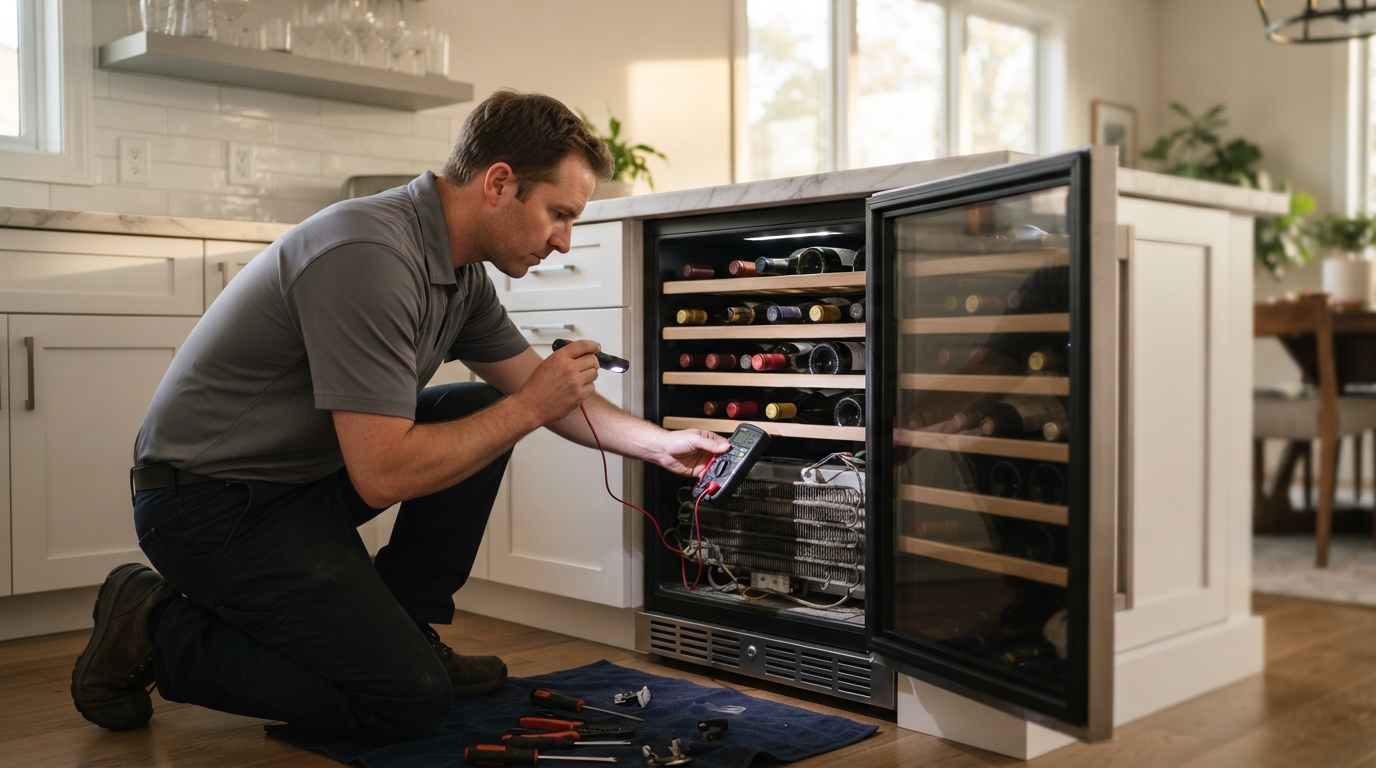
In brief:
• Most wine cooler cooling failures trace back to blocked airflow, dirty condenser coils, or a faulty thermostat rather than a failed compressor.
• Checking power supply, vent clearance, and door seals first can resolve many issues without professional help.
• Persistent compressor or refrigerant problems typically require a trained technician for safe diagnosis and repair.
A wine cooler that stops cooling properly is usually signaling a mechanical or airflow issue rather than total failure, and most problems fall into a short list of recognizable causes. Homeowners who understand these patterns can often narrow down the issue before deciding whether to schedule Wine cooler repair in Phoenix.
Professional Wine cooler repair typically starts with the same diagnostic sequence a careful homeowner would use: checking power, airflow, and temperature readings before assuming a major component has failed. Catching a problem early, such as a blocked vent or a dirty coil, can prevent a minor fault from turning into a compressor replacement.
Common Wine Cooler Problems and Their Likely Causes
Several recurring issues account for most wine cooler service calls. Recognizing the symptom pattern helps determine whether a fix is simple or requires parts replacement.
• Unit not cooling at all : Often linked to a dirty or blocked condenser coil and fan rather than a dead compressor, since a blocked coil forces the system to work harder without resolving heat transfer.
• Inconsistent or inaccurate temperature : A wine cooler’s narrow temperature range means even a slightly drifting thermostat sensor causes noticeable swings compared to a standard refrigerator.
• Compressor runs but cooler stays warm : Suggests a refrigerant issue or a sealed-system problem that usually needs professional diagnosis rather than a DIY fix.
• Unusual noise or vibration : Frequently tied to fan obstruction or loose internal components, especially in units sitting unevenly or too close to a wall.
• Door seal leaks : A worn or broken gasket lets warm air infiltrate, forcing the compressor to run longer and raising internal humidity.
Step-by-Step Troubleshooting Before Calling for Repair
A short diagnostic routine can resolve many issues without replacement parts. Confirming each step in order avoids misdiagnosing the real cause.
1. Confirm the unit is receiving power and that the outlet and cord are functioning.
2. Pull the cooler away from the wall and vacuum the condenser coils and fan, since dust buildup is one of the most frequent causes of cooling loss.
3. Check that interior vents are not blocked by bottles or racks, since restricted airflow prevents even cooling throughout the cabinet.
4. Place a separate thermometer inside and compare it to the display reading to rule out a sensor fault.
5. Inspect the door gasket for cracks or gaps that could be letting warm air inside.
Phoenix, AZ households often run wine coolers in garages, bar areas, or rooms exposed to higher ambient heat for much of the year, which adds strain to the cooling system and makes airflow clearance especially important. The U.S. Department of Energy notes that keeping refrigeration equipment away from heat sources and ensuring proper ventilation supports more efficient operation, a principle that applies directly to wine coolers in warmer climates, according to the Department of Energy.
DIY Fix vs Professional Repair
| Issue | DIY Feasibility | Typical Need for a Technician |
| Dirty condenser coil or fan | High | Rarely needed if cleaned regularly |
| Faulty thermostat or sensor | Low | Usually required for diagnosis and part replacement |
| Door seal or gasket wear | Moderate | Optional, depending on availability of replacement part |
| Compressor or refrigerant fault | Very low | Required, due to sealed-system handling |
Basic cleaning and vent clearance fall within most homeowners’ ability, while sealed-system or electrical component failures call for a technician with the right tools and parts access.
Frequently Asked Questions
Why does my wine cooler run constantly without reaching the set temperature?
Answer: This usually points to a blocked condenser coil, a failing fan, or a thermostat sensor that is misreading the internal temperature, causing the compressor to work without achieving the target range.
Is it normal for a wine cooler to make noise?
Answer: Light humming is normal, but grinding, rattling, or buzzing often indicates a loose fan blade or a compressor under strain, which should be checked before the issue worsens.
Can I fix a door seal leak myself?
Answer: Replacing a worn gasket is often straightforward if the correct replacement part is available for the specific model, though confirming the actual leak source first prevents an unnecessary purchase.
How often should condenser coils be cleaned?
Answer: Cleaning coils roughly twice a year helps prevent dust buildup from reducing airflow and straining the compressor over time.
Based in the USA, the company serves customers across Phoenix, AZ, with publicly available information about its appliance repair services listed on its Google Business Profile.
A Final Note on Diagnosing Wine Cooler Issues
Wine cooler problems rarely come from a single cause, and sorting through airflow, thermostat, and sealed-system possibilities before assuming the worst can save both time and money. Addressing smaller maintenance issues early, such as coil cleaning or vent clearance, often prevents the kind of compressor strain that leads to costlier repairs later.
Published scheduling information for Lux Appliance Care is available for reference regarding service availability.